Streaming an event in Belgrade: what a local crew covers and what you must bring
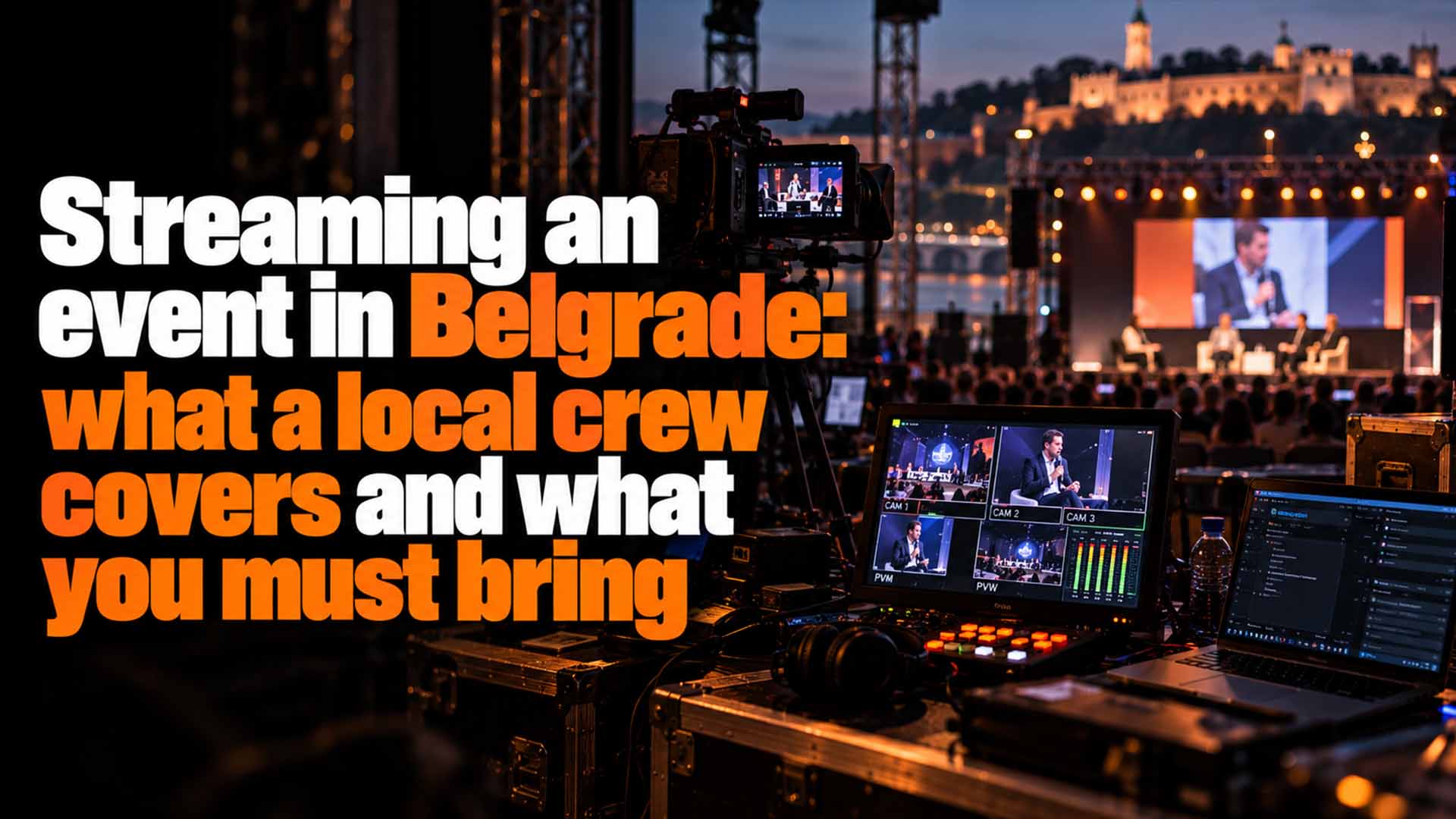
A local crew brings cameras, sound, a vision mixer, live graphics and the person who watches the stream for its whole duration, and broadcasts to YouTube, Facebook, Twitch or a player embedded in your own site. The venue provides power and a wired internet connection. The cost sits well below Western European rates for the same setup, and the single thing to confirm before signing a venue contract is whether the room has a wired line rather than shared wifi.
If you are bringing a conference, a tournament or a series of recordings to Serbia, the production side is usually the last thing arranged and the first thing that goes wrong. This is what hiring a local crew actually covers, and what stays your responsibility.
Why this gets outsourced locally at all
Three reasons, in the order organizers usually discover them.
Cost. The same multi-camera setup costs substantially less here than in Western Europe or the United States, and the difference is in rates rather than in equipment or experience.
Weight. Flying a crew with cases of gear means freight, customs paperwork and insurance, for equipment that already exists at the destination. For a one-day event the logistics cost more than the production.
Local knowledge. Which rooms have a usable wired line, which venues need their own power distribution, which halls have sound systems you can take a clean feed from. None of this is in a venue brochure.
What a crew brings
A standard multi-camera event setup is:
- Two to four cameras with operators, positioned for wide, close and detail shots
- A vision mixer and a director cutting live, as opposed to one fixed angle
- Sound, either taken from the venue’s system or captured with our own microphones, mixed for broadcast rather than for the room
- Live graphics — lower thirds, names, scores, sponsor logos, prepared in advance and tested with the mixer
- Broadcast to one or several destinations at once
- A technician watching the stream from first frame to last, which is the part that distinguishes a production from a camera left running
- The recording, exactly as broadcast
Sound deserves a note of its own. Viewers will tolerate a soft picture and will leave a stream they cannot hear. In a conference room this means a clean feed from the sound desk plus a backup microphone, not a camera’s built-in microphone picking up the room.
What you provide
Two things.
Power at the production position.
A stable wired internet connection. This is the only item that genuinely decides whether the stream works. We visit the room beforehand, measure throughput and stability, and tell you what is missing in time to fix it.
Shared venue wifi is the most common cause of a failed stream anywhere in the world. In a room with four hundred people and four hundred phones, it degrades exactly when the stream matters most. A wired line is always the answer, and arranging one after you have signed the venue contract is harder and more expensive than asking about it before.
So: ask about the wired connection while you are still choosing the venue. It is one question and it prevents the only problem that cannot be solved on the day.
Where the rooms here differ from what you may expect
Worth knowing in advance, because it affects planning rather than quality.
Modern venues are well equipped. Conference centres and newer hotels in Belgrade and Novi Sad generally have wired connectivity, adequate power and usable sound systems.
Older halls and sports facilities are a different matter. Municipal sports halls, cultural centres and school gyms often have neither a wired line nor enough power at the right place. All of it is solvable, and all of it must be established on a site visit rather than assumed.
Daylight and window walls catch people out in glass-fronted venues. A room that looks bright and attractive at ten in the morning becomes a backlight problem by two in the afternoon. This is a lighting and camera-position decision, made before the day.
What this costs
A two-camera setup with a vision mixer and live graphics starts at 690 euros for a single event. A full day with four cameras, a commentary position and a redundant connection is a larger figure, and the quote comes after we have seen the room or discussed it properly.
Invoicing is in euros, by bank transfer, from a European company. Travel outside Belgrade and Derventa is quoted as a separate line so you can see it rather than discover it inside a day rate.
For organizers running a series — a recurring conference, a league, a season of recordings — a seasonal arrangement is noticeably cheaper per event, because the setup is designed once and every subsequent build is faster.
What we have actually streamed
Sports events across Serbia and Bosnia: 3x3 basketball at Pale 3x3 Quest, futsal in Derventa and at the memorial tournament in Doborovci, street basketball, and the Republika Srpska kickboxing championship. Conferences, business events and cultural programmes alongside them.
The recordings are on the live streaming page and can be watched before you call us, which is a more useful reference than any description.
How to plan it
A sensible order, working back from the event date.
- Before signing the venue: ask about a wired internet line and power at the production position.
- Six weeks out: a site visit, and a decision on camera count and destinations.
- Two weeks out: graphics, names, titles and sponsor material supplied, so they can be built and tested.
- Event day: two to four hours of setup, then a test broadcast before the link is given to the audience.
- After: the full recording, and an edited highlight version if you want one.
The only item on that list with a hard deadline is the first one. Everything else can be compressed if it has to be.
Common questions
What does a live stream of a conference cost in Serbia?
A two-camera setup with a vision mixer and live graphics starts at 690 euros for a single event. A full day with four cameras, a commentary position and a backup connection is a different bracket. The figure depends mostly on duration and camera count, and we quote after seeing the room or discussing it in detail, because the power and internet situation decides how much equipment has to come.
Do you work outside Belgrade?
Yes. We work across Serbia and in Bosnia and Herzegovina, where we are based in Derventa as well as Belgrade. For events outside those areas, travel and accommodation are quoted as separate line items so you can see them rather than find them inside a day rate. Sports events in smaller towns are a regular part of what we do.
What has to be in place at the venue?
Power at the production position and a stable wired connection to the internet. That is the whole list. We visit the room beforehand, measure the connection, and tell you exactly what is missing while there is still time to arrange it. Shared venue wifi in a full room is the most common cause of a failed stream and is not something any crew can engineer around on the day.
Can you stream to our own platform rather than YouTube?
Yes. We broadcast to YouTube, Facebook, Twitch and Kick, and to a player embedded in your own site, including a version behind a password or a paywall for ticketed events. Several destinations at once is normal. Confirm the list in advance, because each additional destination needs more upstream bandwidth and that changes what the connection has to carry.
Do we get the recording, and in what form?
You get the full recording as it was broadcast, with the camera cuts and graphics in place, ready for your archive or to publish as is. A shorter edited highlight version is a separate line item and usually delivered within a few days, while the event is still current. Raw camera files can be handed over on request if your own editor will work with them.